Care is Gender Equality: What Japan’s Gender Gap Reveals About Care
2 November, 2026 Purpose Impact Action
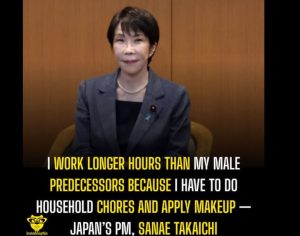
Japan has reached an historic moment: a woman leads the country. Recent remarks by Prime Minister Sanae Takaichi sharpened the gender-equality debate: she said she spends three to four more hours each day than her male predecessors on housework and make-up, prompting criticism that this may reinforce expectations that women should carry more domestic responsibility.
The point is not whether one woman can or should manage an exceptionally demanding role. It is what the reaction reveals about the systems around her. As the BBC World Service’s recent conversation on Japan’s gender gap makes clear, a breakthrough at the top does not, by itself, change the systems that determine whether women can work, lead and make choices on equal terms. Those systems include the largely unseen infrastructure of care.
The BBC episode traces the gap through the places where opportunity is made or lost: Tokyo councillor Risa Kamio describes returning to Japan as a mother and encountering a long wait for childcare. She also describes political meetings that ran close to midnight. Her experience brings the index to life. When the design of work, public services and civic life assumes that someone else will absorb care responsibilities, equal participation becomes much harder to sustain – especially for women.
Representation is a signal. Infrastructure is a condition.
A female leader can widen the public imagination of who belongs in power. But representation alone cannot create childcare places, redesign working hours, improve the quality of eldercare, or redistribute the unpaid work that makes every household function. Those are structural choices, and they shape whether women can take up opportunities once they appear.
This is particularly urgent in a super-ageing society. Care is often discussed as a welfare issue or a private family matter. It is both — but it is also an economic, workforce and gender-equality issue. When care is unreliable, inaccessible or exhausting for those who provide it, families absorb the pressure. In practice, women frequently carry more of that pressure. The result is not only less time; it can mean fewer leadership opportunities, interrupted careers and narrower choices.
The question, then, is not simply how to encourage women to be more resilient or ambitious. It is how to build systems in which their ambitions do not depend on someone else quietly taking on the care. That requires investment in the care workforce, better support for families, and services that preserve dignity for the people receiving care as well as those giving it.
From individual programmes to a system for care
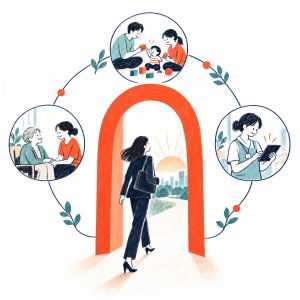
This is the context for Purpose Impact Action’s recent work with the Yoshiko Shinohara Memorial Foundation. The Foundation was established from a belief in women’s independence and freedom of choice. Over time, its work has expanded across scholarships, welfare and childcare support, research, and care technology. The opportunity was not to make each programme work harder in isolation. It was to clarify how the portfolio could contribute to a more coherent, sustainable care system.
Through an evaluation and strategy process, PIA worked with the Foundation to co-create a Theory of Change and an Impact Measurement Framework. The resulting strategic goal is deliberately ambitious: human-centred, technology-enabled care that reduces family care burden, advances gender equality, and strengthens social resilience and long-term economic well-being.
That framing matters because it connects outcomes that are too often treated separately. Supporting care professionals, developing women leaders, improving working conditions, testing practical technologies, gathering frontline insight and building partnerships are not parallel activities. They are parts of the same system. Progress in one area can make progress in another more possible.
Measurement should keep the long term visible.
Gender equality and care-system change do not fit neatly into an annual scorecard. They unfold over years, through changes in confidence, skills, leadership, service quality, technology adoption and institutional practice. That is why the Framework combines short-, medium- and long-term indicators. It is intended to show not just what has been delivered, but whether the conditions for lasting change are becoming stronger.
For funders, this is a useful discipline. It asks: whose outcomes matter? What has changed in practice? What evidence would make a claim credible? And where should learning lead to adaptation rather than premature scaling? These questions make impact measurement more than a reporting exercise. They make it part of responsible strategy.

A gender-equality agenda that starts with care
The BBC interview reminds us that gender equality is not settled by a single appointment, a single policy or a single measure of progress. A woman in the highest office can be an important signal. But real equality depends on whether women at every level can pursue work, leadership and family life without carrying an impossible double load.
Care infrastructure is central to that answer. When care is better designed, better supported and more human-centred, it does not only improve services. It expands the choices available to families, strengthens the care workforce, and makes leadership more attainable. That is why care belongs at the centre of Japan’s gender-equality conversation – and why philanthropic capital, used strategically, can help demonstrate what a different future looks like.
Care should not limit women’s freedom. It should enable human and economic potential.
By Pia Wong
Founder & CEO, Purpose Impact Action
If you are interested in moving beyond good intentions, to build a robust, evidence-based impact measurement framework for your organisation, contact us to learn more about who we can support you on your impact journey.